I was asked if I could write a little something even though I can't post pictures at the moment.
I'm in Gabon, on the west coast of Africa, and on the equator.
French is spoken here, but in addition to this, in the particular area in which I'm staying (Mouila) the African dialect spoken is Pounu. If two Gabonese are speaking French, it's probably because they're from different areas of the country.
My project here in Mouila is to teach some of the women and girls a little about simple baking at the mission where I'm staying and working.
Mango trees grow here as do coconut palms, limes, bananas, and plantains. Taro and manioc are also staples in the diet as well as rice and peanuts. There's a river visible from the mission grounds, and fishing takes place, as it does, of course, on the Atlantic Ocean coast (we had some very nice barracuda while in the capital of Libreville).
Although, very sadly in my opinion since the ground is apparently very fertile, most of the food eaten in Gabon is in fact imported (from other African countries as well as different areas of the world).
Not that I'm saying they're a food source, but I'm 99% sure I heard there are no horses at all in Gabon- which in many ways is sort of a strange thought since horses played a huge part in world exploration. It's very easy to imagine horses are everywhere, but I'm thinking they were never here.
I would rather not go into great detail right now, because I have plans of writing more about it down the line (I WISH it would happen sooner rather than later, but there's not much I can do about the picture issue). My reasoning is because I think photos are very important, and can do far much more than words at times.
Friday, September 27, 2013


Tuesday, September 17, 2013
Stay Tuned...
So...
I'm in Africa at the moment.
I thought I would be able to download photos from my camera, but for some reason things don't seem to be cooperating with me.
Although, with internet access I guess I can't really complain since this wouldn't really be considered "roughing it"- it's better than Ernest Hemingway (but I'm not on safari).
If at some point I'm able to get the photos going and I can write, I will certainly do so.
If not, things photos and words will have to wait until I get home.
I'm in Africa at the moment.
I thought I would be able to download photos from my camera, but for some reason things don't seem to be cooperating with me.
Although, with internet access I guess I can't really complain since this wouldn't really be considered "roughing it"- it's better than Ernest Hemingway (but I'm not on safari).
If at some point I'm able to get the photos going and I can write, I will certainly do so.
If not, things photos and words will have to wait until I get home.
Tuesday, September 10, 2013
Lime and Pistachio Cake


I think it would be particularly nice with a cup of tea!

Serving options:
a drizzle of honey
softly whipped cream
mascarpone
raspberries
peaches/apricots/nectarines


... maybe add just a bit of freshly ground cardamom to the batter along with the vanilla and lime zest.


Lime and Pistachio Cake
Adapted from a Donna Hay recipe
makes 1, 9x5 loaf (serves 8-10)
1 c (130 g) ground pistachios
1 T (9 g) corn starch
1 1/2 c (180 g) almond flour
11 T (1 stick plus 3 T or 150 g) butter, softened
3/4 c (165 g) sugar
1/2 t (4 g) salt
2 limes, finely zested
1 vanilla bean, split and seeds scraped (or 2 t/10 ml vanilla extract)
4 large eggs, room temperature
Preheat oven to 325 F (160 C).
Lightly grease a 9x5 inch loaf pan, and line the bottom with a layer of parchment paper.
If you are able to weigh the pistachios, place them in the bowl of a food processor and pulse several times until the nuts are broken down a bit. Add the cornstarch and continue to process until the mixture is relatively well-ground. If not able to weigh the pistachios in grams, grind a generous amount (being careful not to over grind and create pistachio butter), measure out 1 c, and incorporate the corn starch. Place the pistachios in a bowl and combine with the almond flour. Set aside.
In the bowl of a mixer fitted with the paddle attachment, cream the butter along with the sugar, salt, lime zest, and vanilla several minutes until light and fluffy. Scrape down the sides of the bowl, and add the eggs one at a time, beating well after each addition. Scrape down the sides of the bowl again and beat another few minutes until the mixture is well blended. Add the pistachio and almond mixture, and thoroughly fold the nut flours into the batter.
Spoon the cake batter into the prepared loaf pan and smooth the top. Bake in the preheated oven about 1 hour and 5 minutes, or until a toothpick inserted near the center comes out with a few moist crumbs attached and the cake springs back when lightly touched.
Let the cake cool at least 20 minutes in the pan, then upturn onto a wire rack to cool completely.
Slice and serve as desired.
Saturday, September 7, 2013
Salads and Menu Planning

Salads are one of those things that people either love to make, or hate to make.
At our house, receiving an assignment for making the salad for dinner could usually elicit a groan (this was, no doubt, because salads are both tedious and completely boring).
Having said that, I don't think people are quite so strongly polarized when it comes to actually eating salad.


Most of the time I prefer to make plated composed salads to tossed salads- for several reasons.
It was always one of those frustrating things that once a salad is tossed, all of the exciting additions to the greens fall to the bottom of the bowl. If the person plating the salads wasn't paying attention or didn't care, those people at the beginning of service would end up with a plate full of leaves, while others would have some leaves along with lots of the other goodies mixed in.
Composed salads are visually appealing and even when it comes to those extra things that make salads specific.
Things are arranged more neatly and divided more evenly.
Part of the problem with those composed salads is that they take a little more last-minute time and attention. It's fine if you're organized and all prepared, but can be a tad difficult if you're in a rush.
My preference are the more "green" greens, such as a spring mix that includes a variety of lettuces and other greens such as spinach and arugula.
And please don't think that just because all those greens look like leaves they all taste the same. Nope.
While they could be subtle, the differences are there.
Some, like arugula or watercress, are peppery. Others, such as baby spinach and some of the more delicate lettuces are silky and buttery.


Another great reason for the composed salad: once very delicate greens are tossed with a vinaigrette they being to wilt. They will remain more their fresh and perky selves without being fully coated in vinaigrette. The effect isn't quite the same if someone either sits down to, or is served a flat salad.
It's not so much a problem for the more sturdy lettuces like iceberg or romaine.
But nutritionally, there's more value vitamin and mineral-wise in the deeper, darker greens. Just keep that in mind when creating a salad or making a choice at the market.

Everything in a salad has a purpose (or more likely, they have more than one).
Some things add color, others bring texture to the dish (both visual and gustatory/tactile), and others add variety of flavor. All are important to think about when making a salad.
I'm not quite sure if I've mentioned all of this before, of if I've only thought about saying it (so bear with me here). I think it's important to think about all the elements when putting a salad together. In fact, I sort of go about putting a salad together in the same way I put a meal together. Let's say it's three courses: salad, main, and dessert. Fist thing is to choose a place to start and build the meal around that. Maybe I choose the dessert first: crème brûlée. Then I think about things that are characteristic for that dessert- let's say cold, delicate flavor, and cream. I don't want a lot, or maybe even any, cream in the rest of the meal. Creamy dressing on the salad, heavy creamy sauce with the main, creamed spinach for the vegetable... it's too much. That, and I don't want a plate full of creamy shades of white (sorry, but it's not the most appetizing thing to see).


Another way to go is to balance things that compliment and contrast at the same time. The main could have a lot of flavor if you use ingredients like wine, lemon, garlic, and herbs. What about a roast chicken or roasted chicken breasts?
When I serve a main, it's usually with a vegetable and a starch. Because we're planning on a meat with a lot of flavor, at least one of the sides should have a quieter tone. Let's say a rice pilaf made with chicken broth, onion, and herbs, with flavors that aren't overly bold and don't fight those of the meat.
And for the vegetable? I might go with roasted garlic broccoli. It has it's own flavor, a kick with the red pepper flakes, but in my opinion it still works with the rest of the meal. Maybe sauteed asparagus (a little olive oil, salt and pepper) would be nice as another option.
I don't necessarily think you have to stick to one style, theme, or country when planning a meal, but the foods do have to work together in some sense.
They can contrast to some extent, but they still have to be complementary. To round it all off (and to start), a very fresh-tasting salad with freshly made vinaigrette, very simple with just a variety of greens and the vinaigrette if the main is more complex, and as things turn out it's not a completely overwhelming meal to the senses (though hopefully it's appealing).

So hopefully, with that short meal analogy, there's a sense of how a salad can be put together. Think of variety, think of flavor, compliments and contrast, along with colors and textures.
I hadn't planned on writing so much as I look back at this- it's just salad.


And that salad I made...
I started this post a while back. The salad looked good, but I wasn't a huge fan of the vinaigrette... I'll have to work on it a bit. There were certain flavors I wanted to include, but it didn't quite work out.
I started this post a while back. The salad looked good, but I wasn't a huge fan of the vinaigrette... I'll have to work on it a bit. There were certain flavors I wanted to include, but it didn't quite work out.
The addition of raspberries was an afterthought- that bit of extra fruitiness was really nice and it certainly helped.
That said, I know I said it's great to make something that's visually appealing in addition to being pleasant to taste. But I (and hopefully everyone else) would much rather eat something that tasted fantastic but didn't look exceptional than having things the other way around. And that's why this particular salad will not be served to anyone any time soon.
Once the vinaigrette is "fixed" I think some other potential additions could be:
sliced strawberries
ripe cubed mango
avocado
grilled chicken
Friday, August 23, 2013
Pastry and Science

In the pastry realm, one has to be exact for the appropriate outcome. Structure and behavior are determined by the correct ingredients and measurements as well as reactions. It's much more chemistry-oriented than what goes on in the savory side of the kitchen.
One can add this and that to a soup (or "forget" to add something) to change the flavor and it won't generally change the soup's form. However, if you forget baking powder or baking soda to your cake, it will probably be hard and flat since the leavener wasn't there to make it rise.
A chemical reaction takes place to make a cake rise.
Along with seven chefs, a coworker and I recently took part in a class at the Callebaut Academy in Chicago taught by Spanish chef Jordi Puigvert. The content was science-oriented information for plated desserts, confection, and pastry. More specifically, it was what is called modern pastry, molecular gastronomy, or culinary physics.
It's about changing the expected textures, chemical phases (solid/liquid/gas), and tastes into something new, and you end up with something surprising and unexpected on the plate as well as for the palate. Those things one might expect to only be appropriate as a visual garnish and not add much to the flavor aspect of a dish easily change the notion.
Here are some examples of a few things we worked on earlier this week.

Blood orange and mint whipped gels.
You might expect them to be gummy, but they aren't. The texture is very light, and more like a vibrantly flavored sponge cake that melts in the mouth. The whipped gels are easily cut and added to other deserts.

A fruit puree mixed with a few other ingredients and dripped from a bottle can create...


Raspberry caviar

Microwave chocolate sponge cake pieces, topped with a quenelle of milk chocolate and macerated semi-sorbet, raspberry flexible ganache, chocolate "clay" coated in raspberry powder, raspberry caviar, and a piped chocolate and blackcurrant frozen foam. Underneath is either a crumbed "dehydrated" peanut paste or hazelnut paste.

Piping the microwave chocolate sponge cake from an N2O charged whipped cream canister to create the light and spongy texture for the cake.

Unmoulded frozen chocolate mint mousse

Dipped into a cocoa glaze while frozen, chocolate mint mousse is placed on a bed of chocolate crumbles and becomes is the center of a dessert flanked by spheres of chocolate and light licorice panna cotta, cubes of whipped mint gel, basil cream, and a cocoa and licorice sauce.


Spherification of blood orange and passion fruit puree-
a very thin semi-solid layer holds the puree inside

A squiggle of lime and white chocolate curd, lime crumble, orange juice soaked passion fruit sponge cake, whipped blood orange gel, white chocolate and passion fruit flexible ganache, orange and passion fruit spheres, topped with a lime and white chocolate semi-sorbet and lemon bubbles.
(Sorbets will eventually melt and bubbles will eventually dissipate... even for chefs.)

Blackcurrant and chocolate marshmallows

The photo above shows piped interiors of mojito truffles, below are the finished truffles on either side of chocolate-coated pina colada dragees with coconut cubes, pineapple and lime flavors.


Smooth interior sesame and hazelnut truffles coated in chocolate and rolled in caramelized sesame seeds (center)... (apparently you can finish a 1kg bag of the seeds at the cinema- no problem), flanked by vibrant-tasting lime, basil, and yogurt truffles, some chocolate-coated and others left uncoated.


Chocolate financiers with a heat-resistant raspberry filling. The raspberry slice is like an extremely thick jam, reminiscent of membrillo, that very easily dissipates in the mouth. When the cake is cooked the raspberry will melt, but it solidifies again once the cake cools.


Frozen green apple mousse being coated in thin fruit glaze

Yogurt foam spooned into a mould and frozen so it can be sliced

Green apple mousse moulded around apple confit cubes, vanilla mousse, and an eggless caramel bavaroise, dipped in apple glaze, placed upon a bed of yogurt and green tea sponge cake, iced apple gel, frozen yogurt bubbles, apple meringue, and sliced fresh green apple.

Saturday, August 17, 2013
Coconut Macaroons and Mango Sauce

While much of the time we are able to do what we want and try creating new flavor combinations and confections at Kakao (provided we have the time for it), every now and then we have "assignments" or "challenges" for the confectioners at the shop.
I suppose you might call it forced inspiration.
Called Peculiar Pairings, we're given an ingredient or a style and we're supposed to create a confection with it in mind. For example, in the very recent past we've had "Indian" and another using local craft beers. Sometimes the ideas come easier than at other times.
Then there can be the whole question of how to go about making actual the flavor and texture that you happen to envision...
The pairing coming up soon is "comfort food." Well, I couldn't quite come up with anything. I racked my brain trying to think of what I might personally use as comfort food. Suggestions were there, the worst was mashed potatoes, but it was thankfully a joke (what in the world would I do with that even if I wanted to?). I thought of Cheetos myself, and while they fit the bill for comfort food (a good reason I do not buy them) and they do happen to be more usable in their form and texture than the potatoes, I decided that I wasn't ready for Cheetos and chocolate. It might take more finesse than I am able to provide the project. Then again, maybe there's no amount of finesse that would take care of the Cheetos.
Truthfully we do sometimes use things in our confections that one might not immediately expect as appropriate for sweets. But very often, the slightly odd is what people expect from us anyway.

It's not a crunchy, salty snack, but I finally decided on tea for the comfort food I would utilize. Ok, so I suppose it's technically not a food, but I do find tea comforting (in the evening, when it's cold outside, if I'm sick, as an accompaniment to a book). I especially like a good lavender earl grey.
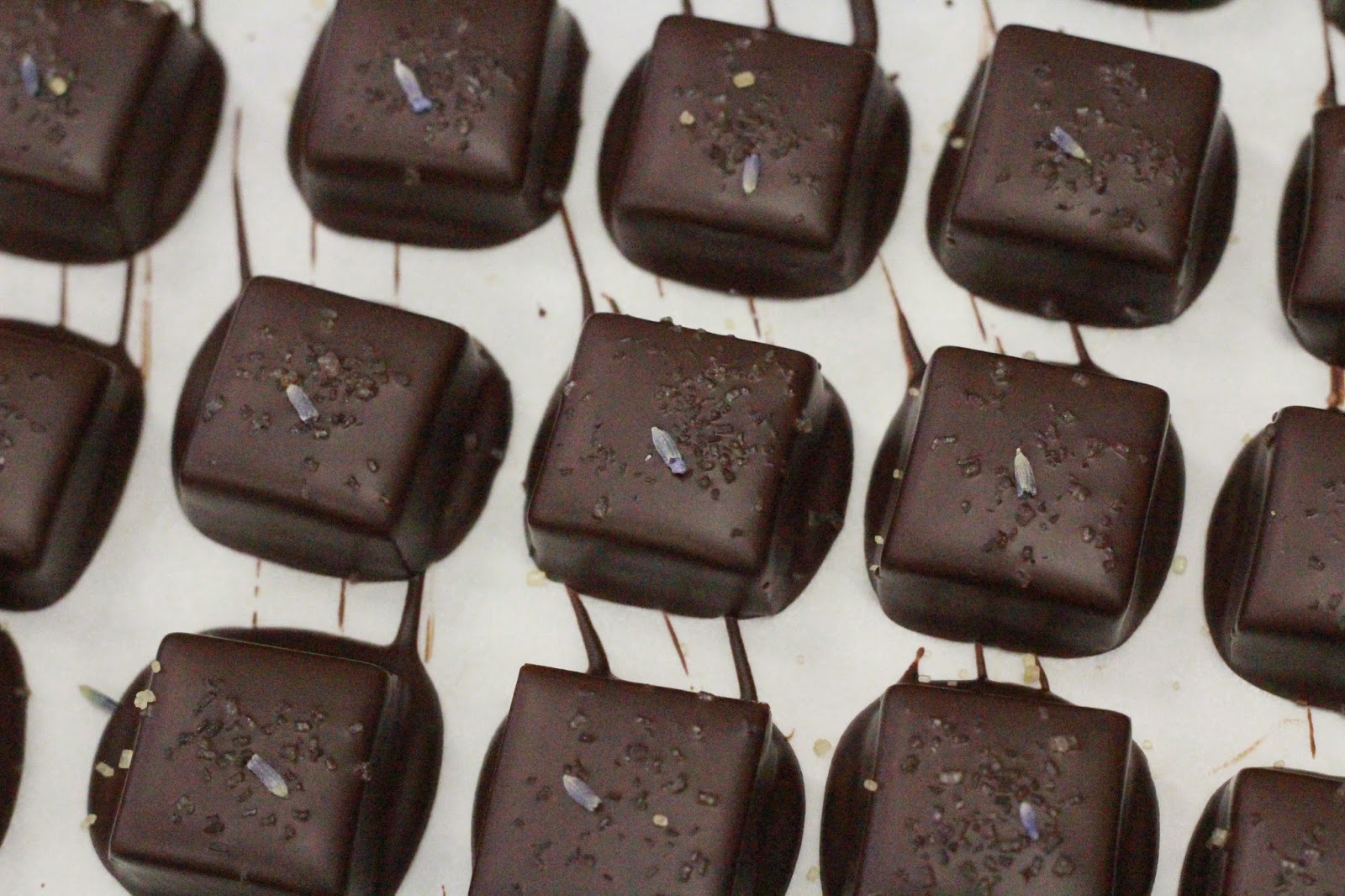
And so, to create the flavor, loose earl grey tea leaves and dried lavender buds were infused in cream. The infused cream was then used to make a batch of caramel. Ta-da.
The caramels were cut and dipped in 72% dark chocolate, topped with a sprinkle of raw sugar for the tea, and one lavender but as an identifier and flavor booster.
While certainly I like it, I have a couple ideas of how I would change it if I made it again...
In addition to all the chocolate, Kakao also carries ice cream from a local ice cream shop. We have two flavors available: a natural vanilla, and classic chocolate.
In addition to the things we have to offer in the day-to-day made in-store (salted burnt caramel sauce, chocolate sauce, lavender syrup...), we also have a specialty sundae every two weeks or so.


Don't get me wrong, it's great chocolate. Most, if not all of us, who work at Kakao eat chocolate every day. The good news is that if you have good chocolate, you don't need as much of it to satisfy a chocolate need.
Maybe that shouldn't be a blanket statement. Maybe quality doesn't matter as much as quantity for some people, but it does for me.

Anyway, the point I was trying to make is that since we're working with chocolate all the time, we frequently crave other flavors. Sometimes it's nice to work with other foods, flavors, and textures to see what we can come up with.
Back to the ice cream...

So, I wanted to make fresh mango sauce for vanilla ice cream and serve it with a coconut macaroon.

(And no, the photo below does not show toasted coconut.)

So, this time around, two recipes in one post, though they certainly don't have to go together (they just did for my purposes).
Use them however you would like. Or not.
I understand that coconut is one of those things. People are either coconut lovers or coconut haters. The grey area seems very small in this instance, and opinions can be quite strong.
If you happen to like coconut and feel like taking things a little further, temper some good dark chocolate, dip the bottom half of the coconut macaroons, and place them on parchment to set.

As far as the mango-lime sauce goes, it's very nice poured over good vanilla ice cream (sweet and creamy goes well with the fruity and slightly tart sauce- they seem to enhance each other), but it would also be great spooned over cheesecake, with fresh strawberries, or over pound cake with some whipped cream.
Coconut Macaroons
makes about 48, 1 T cookies
14 oz (397 g) unsweetened coconut
14 oz (397 g) sweetened condensed milk
1 t (5 ml) vanilla extract
2 large egg whites, room temperature
1/4 t (1 g) kosher salt
2 T (32 g) granulated sugar
Preheat oven to 325 F/160 C.
In a large bowl and with a spatula, mix the coconut, condensed milk, and vanilla until well combined.
In the bowl of an electric mixer fitted with the whisk attachment or with a hand mixer, whip the egg whites together with the salt until soft peaks form. While the mixer is running, slowly add the sugar and continue whisking until stiff peaks form. Gently fold the egg white mixture into the coconut mixture until incorporated.
Using a small cookie scoop or spoon, portion out the macaroon mixture in about 1 T (visually 15 ml) mounds onto parchment paper lined sheet pans.
Bake the cookies in the center of the oven 15-20 minutes, until golden, turing the pan back to front about 8 minutes through the cooking time.
Remove the pan from the heat and let cool before removing the cookies from the paper.
(*Coconut macaroons freeze well.)
Mango-Lime Sauce
makes a generous pint (more than 473 ml)
about 2 lb. (907 kg) ripe mango
3 T (45 ml) water
1/4 c (50 g) brown sugar
2 T (30 g) coconut oil
1/4 t ( 1 g) salt
2 1/2 T (around 37 ml) fresh squeezed lime juice
Cut the mango fruit from the flat central seed. To do so, I like to use the stem as a guide and cut the "cheeks" away from either side. If it's difficult you may be cutting too deeply, and into the seed. Then score each half mango on the flesh side 3-4 times in one direction to the skin but not through, and then 3-4 times perpendicularly through the flesh so you have a grid cut into it. Flip the skin inside-out so that the cubes you have cut separate from each other and appear to pop out from the skin. Using a spoon, scoop the cut mango from the skin and into a medium saucepan. Repeat until all the mango is in the pan. Don't forget to peel the skin from the perimeter of the seed and cut the fruit that's still around the seed off into the pan with the rest of the mango.
Add the water, brown sugar, coconut oil, and salt to the pan with the mango. Simmer over medium-low heat 3 minutes, stirring several times to make sure the fruit doesn't scorch.
Let the mixture cool slightly and then pour everything into the bowl of a food processor and process until smooth. Add the lime juice and process again until combined. Taste and adjust as necessary (salt, lime juice, a little extra water to thin the sauce).
If not using immediately, let cool completely, place in a covered container and refrigerate until ready to use (the sauce should be fine several days in the fridge). Bring to room temperature before using.
Wednesday, August 7, 2013
Argentinian-Style Flank Steak and Chimichurri
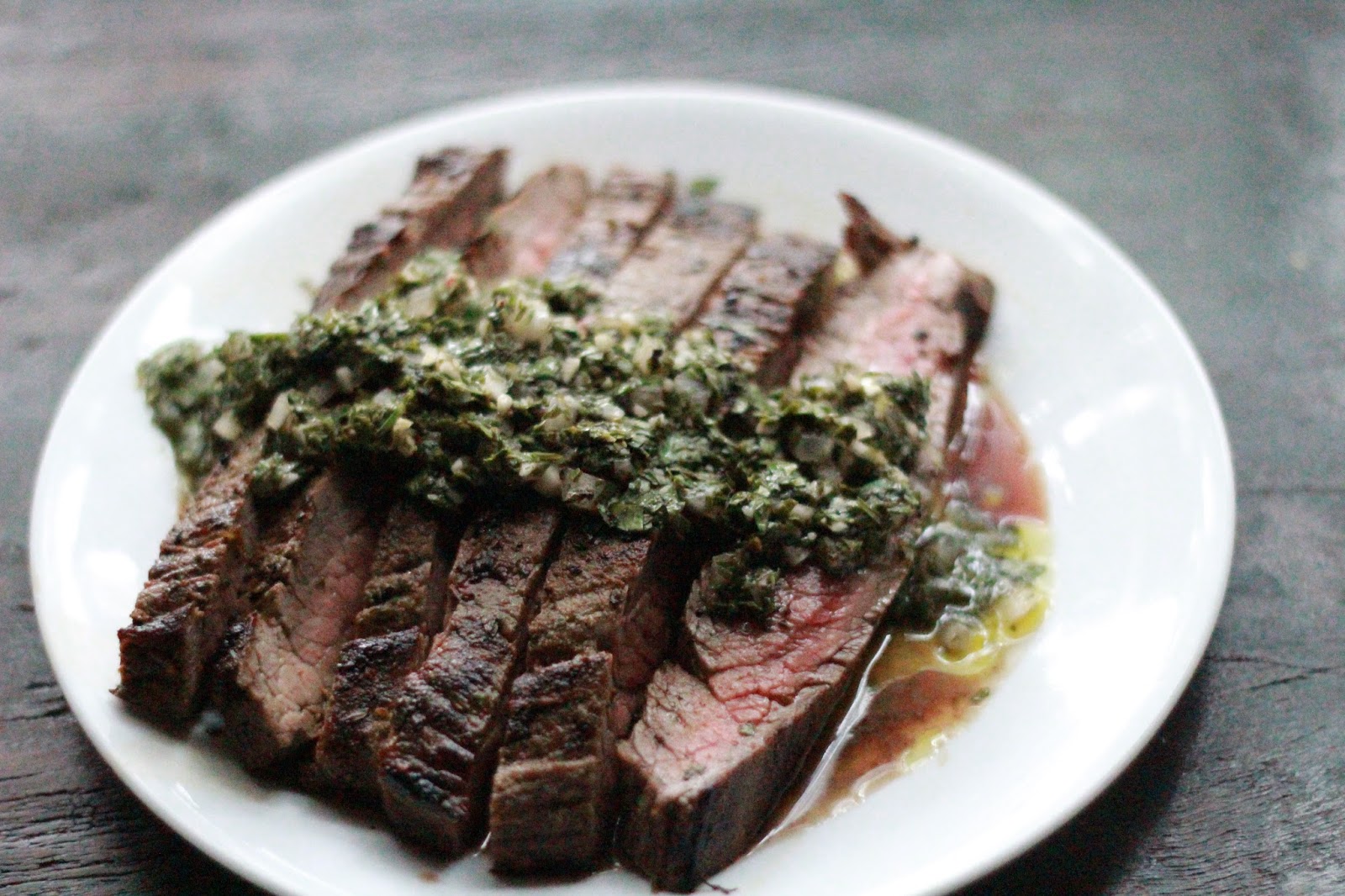
Grilled foods are such a nice summery option. The only problem is that I'm not exactly grill-proficient. I do like the grill- vegetables are fantastic and easy to gauge, hamburgers aren't difficult to tackle, and neither are things like a pork shoulder that have a low heat and extremely slow cooking time.

My problem happens to be those things that need a somewhat high heat and more controlled cooking time for a perfect medium-rare. Problem being that I can't seem to obtain the necessary control for long because the grill I use decides to suddenly drop in temperature. It's finished for the day, it's not going to do any more work.
Then the timing doesn't work out because the temperature decided not to cooperate. You're at the point when you have meat that's partially cooked, but you have no idea exactly HOW cooked it is, and maybe you're not certain how long the temperature was at the desired level before it dropped... well, what is one supposed to do?
Rather than spearing the steak to check it's doneness and lose all the juices, I prefer something a little more consistent from the beginning.
For precision, I prefer to cook on the stove. See, I'm comfortable with that. A grill pan is great, but a heavy frying pan such as one made of cast iron will also work well. The grill flavor may not exactly be there (sorry), but a really nice sear can still be attained.
If you're happy with your grill and comfortable using it for something like this, have at it. I'm sure you'll be pleased.

That said, cooking your meat more rare or more done is completely up to you. I don't plan to give instruction on how to play Russian roulette food poisoning (do you trust your butcher?) or grill up some nice hockey pucks. But I don't know that either of those require much instruction- and if that's what you like, it's your dinner.

One other thing is that the cooking method in the recipe is the one I always use for a flank steak: hot pan, salt and pepper the steak, cook on one side, turn and cook on the other, let the meat rest off the heat in the pan. It's my basic flank steak how-to, and I like how it turns out.
The "different" thing in this case is the marinade and chimichurri (which tastes like green and garlic with a little bite).
Earlier on I had a recipe for some steak and chimichurri, but I think I like this version much better.

If you're looking for a different herby green sauce for flank steak, a fresh basil pesto might be nice.


You'll just have to imagine what the vegetables would look like.
Argentinian-Style Flank Steak and Chimichurri
serves 4-6
Marinade adapted from a recipe in Gourmet, August 2008 (originally adapted from Abingdon Manor)
Marinade:
1/4 c (60 ml) vegetable oil (sunflower, peanut)
1/2 c (120 ml) white vinegar
1/2 c (32 g) chopped fresh cilantro (stems are fine to use)
3 large cloves garlic, minced
2/3 c (80 g) chopped onion
1 T (2 g, or 15 ml if weight is too small to measure) fresh minced thyme leaves
2 t (1 g, or 10 ml) fresh minced oregano
1 1/2 t (5 g) ground cumin
1 1/2- 2 lb (680-907g) flank steak
Before cooking: kosher salt and freshly ground black pepper
Chimichurri:
1/4 c (60 ml) red wine vinegar
1/4 c (60 ml) olive oil
1/4 c (33 g) minced onion
3 cloves garlic, minced
1 1/2 t (7 ml) lemon juice
1/3 c (24 g) minced fresh parsley, lightly packed
2 t (3 g, or 10 ml if weight is too small to measure) minced fresh oregano
a nice pinch of hot red pepper flakes
1/2 t (2 g, or 2.5 ml) freshly ground black pepper
3/4 t (6 g) kosher salt
While the steak marinates, make the chimichurri.
Stir together all chimichurri ingredients in a medium bowl. Set aside and let stand at least 2 hours so the flavors meld.
When ready to cook the steak, heat a large heavy frying pan or grill pan over medium-high heat a couple minutes. Remove the steak from the bag and wipe off excess marinade. Generously salt and pepper the steak and place the steak seasoned-side down in the hot pan. Salt and pepper the other side as the first side cooks. For a 2 lb. steak, cook 8 minutes per side for medium-rare. For a smaller steak, 1 1/2 lb., maybe 7 minutes per side.
When the first side has finished cooking, flip the steak and cook on the other side. Remove the pan from the heat and let the steak rest in the hot pan about 10 minutes.
Slice the flank steak against the grain and serve with the chimichurri.
Subscribe to:
Posts (Atom)


 Posts
Posts


