Showing posts with label travel. Show all posts

Sunday, December 1, 2013

Baking Bread in Gabon


There is a future plan for a boulangerie with a wood-fired brick oven at the mission. 
Pretty neat, but you have to remember that a boulangerie in Africa will probably be a bit more rustic than one in France.

For one thing, "climate control" isn't usually going to be an option. Don't get me wrong, it certainly can be, but it's not something many people are really used to in day-to-day life.
Plus, the money has to be there for the endeavor, and pretty much all the necessaries would have to be imported.

If you're in Africa, making baguettes may not be quite as straightforward as it would normally be.
You'll have to make some changes, to adapt.

Baguettes should take at least 12 hours from start to finish, and preferably more time for a better flavor development. While the dough rises, you'll need to protect it.
In the bakery, there are several inches of  space between the tops of the four walls and the overhanging roof.  Sometimes lizards hang out on the tall ledge and look down on what was going on below. Maybe it was curiosity, maybe it was strategy, but some evidently made their way down into the bakery overnight (hey, they leave evidence).
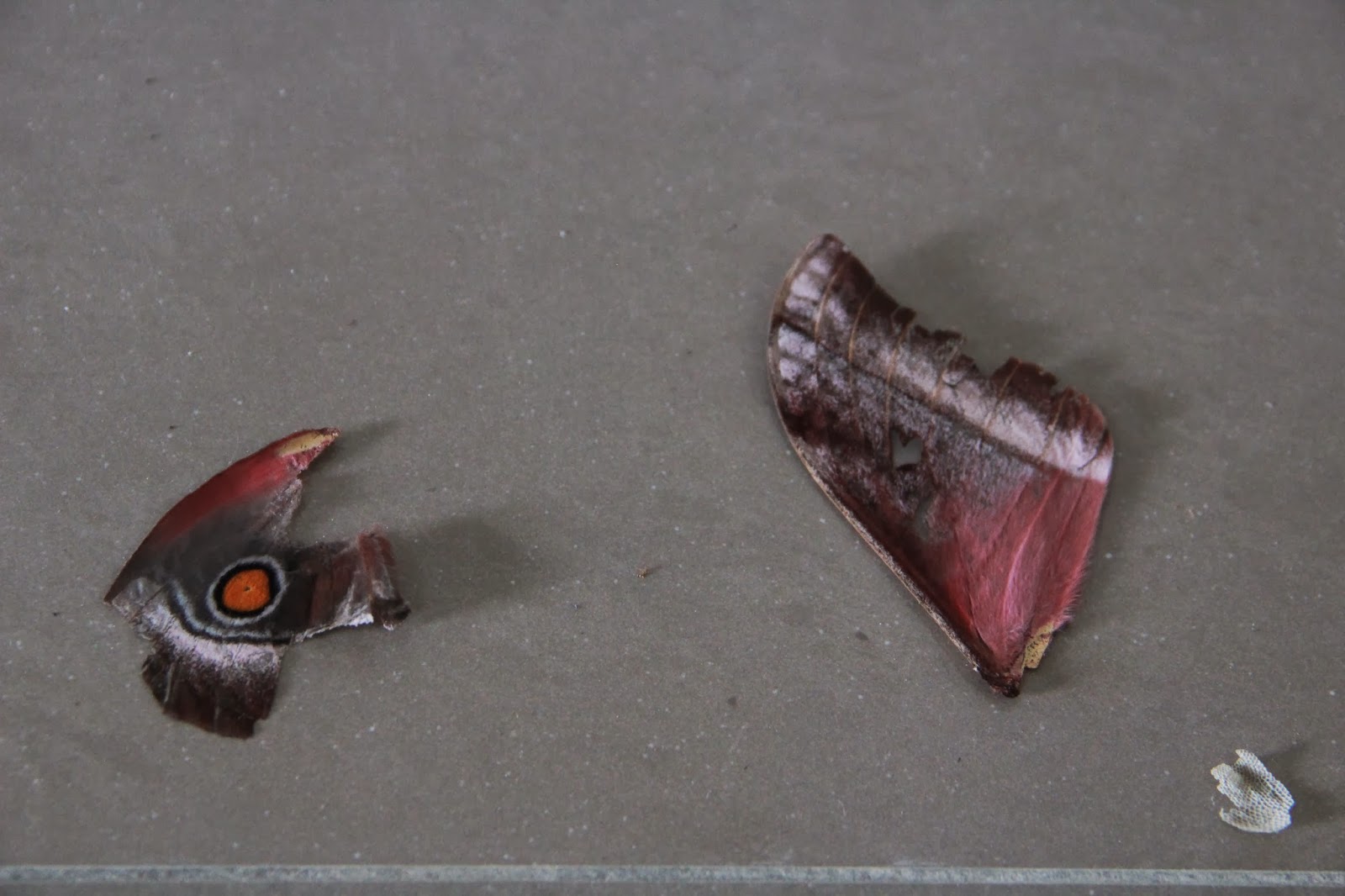

Lizard skin and pieces of butterfly wings- it looks like it must have been a pretty one, but the butterfly lost. I don't think it had a chance.

And no joke, bugs are prevalent. From les petites fourmis, to les mouches, to... I don't even know what many of those bugs were called since I'd never seen anything like them before, you'll have to keep
them out of the rising bread dough.
The setup is a little more rustic, so if you plan to bake, this is where the adaptation comes into play. 

Though it didn't matter what had gone on the previous afternoon, I would walk in pretty much every morning to find at least a few bugs on the counter, dead or alive.

To keep the little things out during overnight rising, you could use an overturned storage box. 


Everything is protected, fully contained, and the rising environment stays warm and consistent.

While a tile-topped counter is definitely a plus for kneading and rolling dough, a water bottle filled with ice water can make a suitable substitute when there's no rolling pin. 


In a pinch a floured bed sheet will suffice as a baguette couche. 


If you don't have a razor to slash the bread, a sharp (and clean) pocket knife will do the trick. 


Even if the situation isn't completely ideal, you can still figure things out- and maybe the challenge makes it more worthwhile.

Monday, November 4, 2013

What Are We Working With?


In this area of the world AC is rare. Not many have cars. No running water- bathing is done in the river or with the jugs of water someone has carried back home. Electricity in the little shack? Nope. 
Interestingly, everyone has a cell phone, but it'll only be re-charged if an extra outlet is found when people are out and about.


Children don't really have many toys, and in fact we saw some playing with trash. Taking a walk and trailing a plastic bottle on the ground which was connected to a stick. Maybe it was a car, maybe a boat, perhaps it was a pet...
Although sad, it made me think about "the occupation of being a child" from what should be considered my "real" job. Being a child involves filling time with play, activity, and imagination. That's their job, and it's how they learn.
Toys do have a purpose, though they don't require plastic and bright colors. Really, with a little imagination a simple stick can be a fine toy.
Even more sad, some children didn't seem to play at all, but just sat around outside in the dusty red dirt all day.
Many of the adults don't present a good example of keeping themselves occupied during the day either.
In my own American life, I can't say I could do that. Not doing something, not getting anything done all day every day would drive me crazy.


You might think that people would be bothered by this, but from what I heard they don't consider themselves poor or pitiable in any way.

Some people only eat once a day, and even then, it may only be manioc.
Mixed with water, wrapped in banana leaves and steamed, it's pasty and grey-ish, without much flavor at all.
In fact, a lot of the diet seemed to be starchy. There was rice, green plantains, taro, the manioc... at least one African meal had all of these things along with chicken and a condiment of very hot crushed fresh peppers.
Yes, lots of flavor and pain in those peppers. 

My purpose in Gabon, as I had said before, was to teach simple baking, and I really wanted to use what was easily available for that purpose.  I wasn't really sure what I would find.


Amazingly, baking soda (bicarbonate) is available only in the capital, Libreville. 
Baking soda can no longer be taken for granted- it made me think about how I couldn't just run out to the store and pick up even something that simple. If you don't have baking soda, there are a lot of baking options that suddenly disappear.


In Mouila, the grocery stores are not packed chock-full of your wildest supermarket shopping dreams.
The couple stores we did see were far more basic than what we're used to. Bags of rice, flour, sugar, butter, shelf stable milk, red palm oil, eggs, cookies, cans of applesauce imported from Belgium (in fact, most everything is imported, some from Brazil (!?) of all places, but much of it from France... and I'm going to assume this is the case because Gabon is a former French colony).
As small as these bare bones stores were, they did have a very impressive array of liquor for sale.
Chocolate? You can choose between Nesquick and a Nutella knockoff.


When I saw there was Nutella-ish-ness available, I thought I could make a chocolate-hazelnut cookie with the inspiration from good old peanut butter cookies. Although it didn't turn out like a peanut butter cookie, they were successful in their own way as thin and crispy chocolate wafers. Leavening turned out to be completely unnecessary in this case.


The nice thing about this area of Africa is that the fresh fruit is literally growing right outside.  Depending on the time of year there choices could include papayas, mangoes, lemons, limes, bananas, grapefruit, pineapple, and coconut.


I had initially thought that shredded coconut wouldn't be such a hard thing to find.
Think again: you'll probably have to do it yourself.


First thing's first: find someone who's handy with a machete.
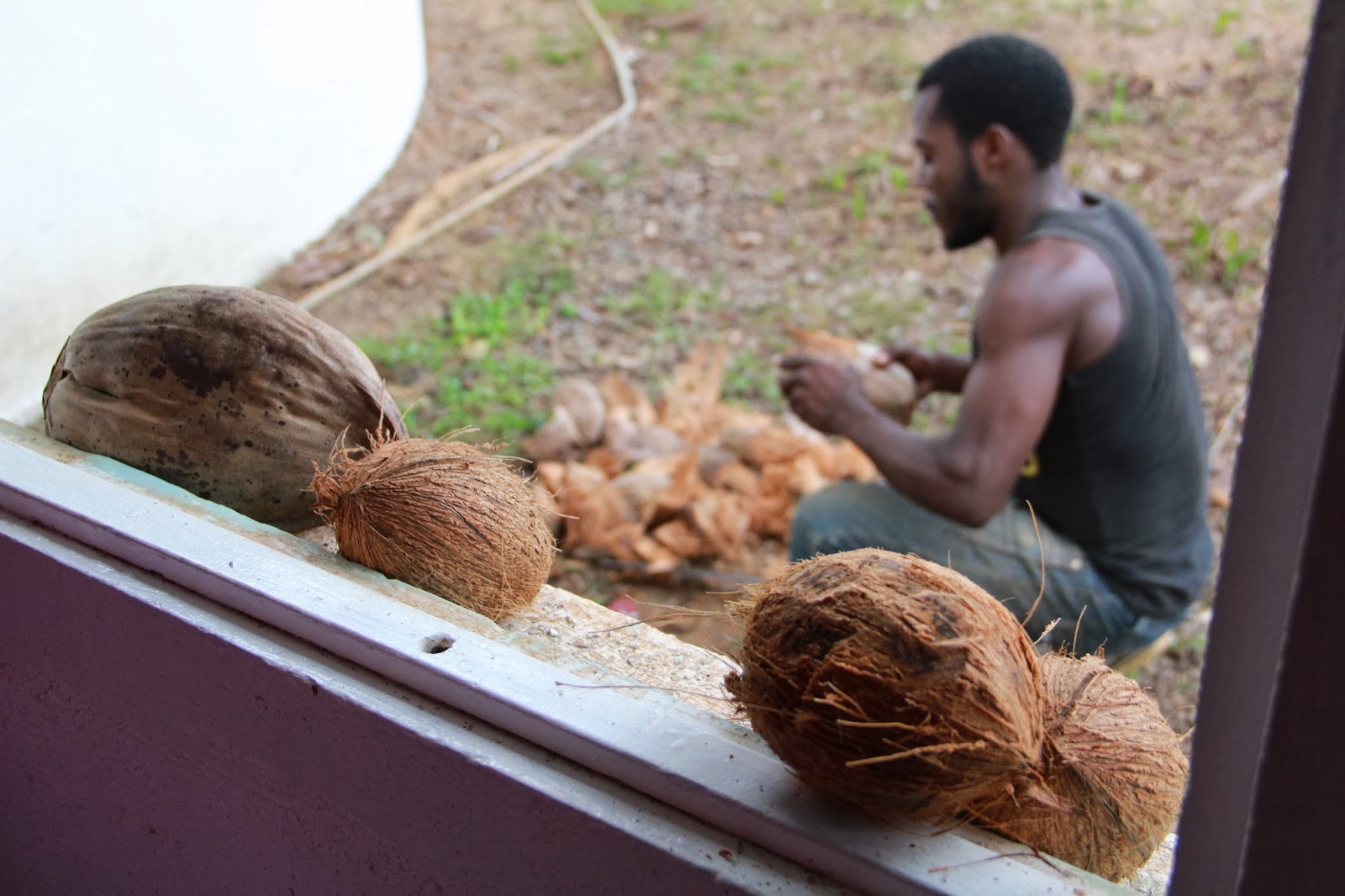
Coconuts right off the tree need to be peeled with a machete so the husky brown shell is exposed.


Then the top is cut off so the coconut water can be drained. And wow. It's so much sweeter and flavorful than the boxed coconut water you find at the grocery.


The next step is to whack the shell with the back of a knife so that the shell cracks, and then wedge the knife blade between the shell and the meat to get the meat off the shell in large chunks.


The coconut is grated by hand, then dried a bit in the oven before the coconut macaroon batter is mixed.
Coconut macaroons are so much better when made with fresh coconut as compared to the dessicated stuff from the store back home...

Friday, October 25, 2013

Dinner Options

Between Libreville and Mouila, most people have a couple of rusty oil drums sitting on the edge of the road (in front of their corrugated metal-roofed shack), showcasing wares for sale. The bounty may include coconuts, plantains, limes, or taro root.

However, it can also include animals they've caught and hung from the stick placed inside one of the oil drums. Monkeys, crocodiles, porcupines, civet cats, fish,  pythons, gazelles, various birds, and aardvarks could be options depending on the day's catch.
If you see something you like, you're certainly welcome to stop and purchase it- maybe haggle over the price (though I can admit I'm not sure what these things are going for these days, and you'll have to figure out for yourself what to do with your prize).
Just note, it's probably better to pick it up earlier in the day rather than later.


Friday, September 27, 2013

A Little More Information

I was asked if I could write a little something even though I can't post pictures at the moment.

I'm in Gabon, on the west coast of Africa, and on the equator.
French is spoken here, but in addition to this, in the particular area in which I'm staying (Mouila) the African dialect spoken is Pounu.  If two Gabonese are speaking French, it's probably because they're from different areas of the country.

My project here in Mouila is to teach some of the women and girls a little about simple baking at the mission where I'm staying and working.

Mango trees grow here as do coconut palms, limes, bananas, and plantains. Taro and manioc are also staples in the diet as well as rice and peanuts. There's a river visible from the mission grounds, and fishing takes place, as it does, of course, on the Atlantic Ocean coast (we had some very nice barracuda while in the capital of Libreville).
Although, very sadly in my opinion since the ground is apparently very fertile, most of the food eaten in Gabon is in fact imported (from other African countries as well as different areas of the world).

Not that I'm saying they're a food source, but I'm 99% sure I heard there are no horses at all in Gabon- which in many ways is sort of a strange thought since horses played a huge part in world exploration. It's very easy to imagine horses are everywhere, but I'm thinking they were never here.

I would rather not go into great detail right now, because I have plans of writing more about it down the line (I WISH it would happen sooner rather than later, but there's not much I can do about the picture issue). My reasoning is because I think photos are very important, and can do far much more than words at times.

Tuesday, September 17, 2013

Stay Tuned...

So...
I'm in Africa at the moment.
I thought I would be able to download photos from my camera, but for some reason things don't seem to be cooperating with me.
Although, with internet access I guess I can't really complain since this wouldn't really be considered "roughing it"- it's better than Ernest Hemingway (but I'm not on safari).

If at some point I'm able to get the photos going and I can write, I will certainly do so.
If not, things photos and words will have to wait until I get home.

Thursday, October 11, 2012

Dandenong Ranges


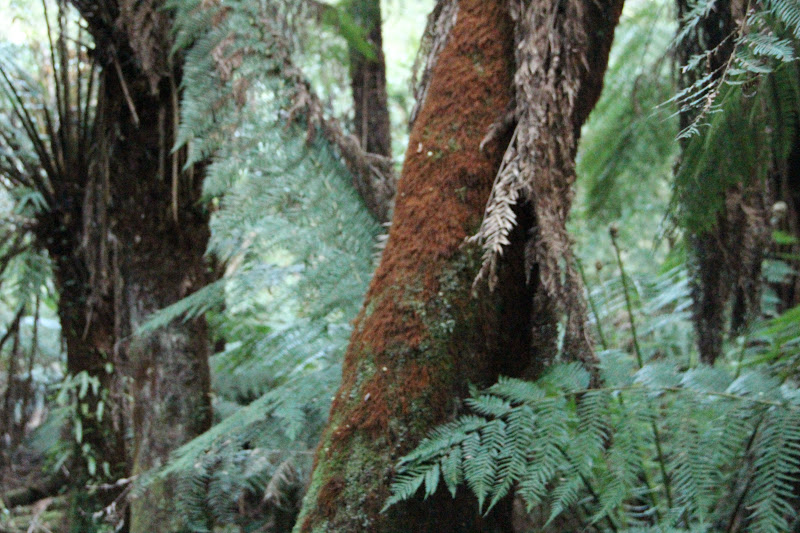
The Dandenong Ranges are an area east of Melbourne. Hills and valley, ferny rainforest, eucalyptus, and countryside. 


Really, some of it was like walking through Jurassic Park.

And I half expected to see some dinosaurs. I would have been good with just one brontosaurus.
But not even a lizard...

I think my some of my favorite scenery was along the side of the road, but there was really nowhere to stop. The road just sort of (neatly) falls away to the side into a deep and steep valley, and well, since I couldn't really get a good photo of it, I have to say that the foliage is very dinosaur appropriate (you'll have to use your imagination).  It's thick, lush, green and vast, and probably much better experienced than read about. 


Apparently the area is at risk for bushfires, and there have been some pretty bad ones in the past. There are signs on the roadside warning of the bushfires- I think at least one sign  had a movable arrow that would indicate the potential risk to passersby. And apparently the people living in the area are trained on how to deal with bushfires.
It's a community effort. 


Since it's something that people ask, no, I did not see any kangaroos. (Yes for jellyfish, pufferfish, parrots, cockatoos, and kookaburras, but no, not the elusive lyrebird. No koalas, no wombats.) 
However, there were certainly kangaroo crossing signs similar to our deer crossing signs.  I guess the kangaroos in Australia can be sort of like the deer at home. 


Monday, September 24, 2012

Sorrento (Mornington Peninsula) and Brighton Bathing Boxes (Melbourne)


It doesn't really have to do with food and cooking, we'll get back to food soon, but these are some really nice views. 

Mornington Peninsula is about an hour's drive south from Melbourne. There's not much land further south before Tasmania. Sorrento is one of the beautiful cities on the peninsula with some gorgeous beaches. 


Brighton is a suburb of Melbourne and the beach is home to iconic and colorful bathing boxes. 


Wednesday, September 19, 2012

Melbourne CBD


Flinders Street Station


Graffiti in the lanes.


Thai for lunch at Chin Chin on Flinders Lane in Melbourne's CBD. Dishes are meant to be shared so everyone has a variety of tastes to enjoy...


The crispy barramundi and green apple salad with caramelized pork, peanuts, chilli and lemongrass was fantastic (the barramundi is actually hiding under the salad). Cilantro, green onion, and mint rounded out the flavor- spicy, savory, nutty, sweet, aromatic... we unanimously decided we could eat it every day.


Dry curry 'pad ped' with stir fried vegetables, spice crusted organic tofu, kaffir lime leaf, and Thai basil included green beans, baby corn, red chillis and caramelized shallots. While all of us had eaten tofu in the past, none of us would consider ourselves tofu eaters- this was one of those dishes that could change that.  


Aromatic yellow curry of roast pumpkin, chargrilled tofu, and green beans. This one was a little coconut-y, creamy, spiced with cinnamon and star anise, red chilli, and Thai basil. Jasmine rice helps to soak up as much of the saucy curry as possible. 
The pumpkin honestly tasted like it could have been dessert. 


But there was a real dessert, of course. We decided on a palm sugar ice cream sundae with salted honeycomb (maybe you know it as a molasses puff or cinder toffee) and lime syrup. The palm sugar ice cream was slightly caramel-y/burnt taste, the lime syrup added a pleasant tang, and the honeycomb a sweet and crispy contrast. And it all melded perfectly.


There's plenty to see in the lanes and arcades around the area... 


Making rock candy at Suga. 


Melbourne's Chinatown


St. Paul's Cathedral