Thursday, November 17, 2011

Balsamic Roasted Beets


Beets were never my favorite vegetable growing up.
They were the kind of thing you ate because you had to. They were the kind of thing that you ate as quickly as possible while holding your breath, eyes squeezed tightly shut.


They tasted like dirt. Not that I ate much dirt, mind you.
Beets and I are better now. And although I must admit they're very similar, I would currently claim the flavor as more earthy than dirty.


They're much better fresh and roasted than they are canned. There's more character, more possibilities to choose from when amping up the flavor.


Plus with fresh beets, there's the added advantage of things looking suspiciously like a massacre took place at the cutting board. It's a nice addition to the repertoire of stain possibilities, so take care not to let  the beets hit any white tablecloths (or shirts). 


This particular beet recipe is a little sweet, a little roasty, savory and aromatic.
They're great on their own, but are also nice as an addition to a salad.


Adapted from a recipe by Giada de Laurentiis in Giada's Family Dinners

Balsamic Roasted Beets
serves 6-8 as a side dish


6 large beets
1/4 c balsamic vinegar
3 T minced shallot
1 T honey
1/3 c olive oil
1 1/4 t kosher salt
1/2 t pepper
10 sprigs fresh thyme


Preheat oven to 400 degrees F.
Peel the beets, cut them in quarters lengthwise, then cut each quarter into thirds (it's easiest if you cut off the pointed end as an approximate third and then cut the larger piece that's left in half lengthwise... I hope this makes sense!).
Place the beets in a large bowl.
In a smaller bowl, combine the balsamic vinegar, shallot and honey. Whisk until the honey is dissolved then whisk in the olive oil in a slow, steady stream.  Add the salt and pepper and again whisk the vinaigrette.
Pour the vinaigrette over the beets and toss well so that all are coated with the dressing.
Place a large piece of aluminum foil on a large sheet pan, and fold up the edges a bit. Pour the beets and dressing onto the foil and tuck the sprigs of time in amongst the beets. Try to make sure the beets are in a single layer. Place another large piece of foil on top of the beets, and crimp the edges of both pieces of foil together so you're left with a tight seal around the edge of the packet.
Roast the beets about 30 minutes. Remove the foil from the top of the packet, being careful not to burn yourself. Place the pan back in the oven and roast another 30 minutes (or more), shaking the pan and gently tossing the beets occasionally, until the beets are easily pierced with the tip of a knife and the outside is caramelized a bit.
Let cool a bit and remove the thyme stems before serving. 
Season to taste as necessary.

Thursday, November 10, 2011

Chocolate & Confection


chocolate |ˈ ch äk(ə)lit; ˈ ch ôk-|nouna food preparation in the form of a paste or solid block made from roasted and ground cacao seeds, typically sweetened : a bar of chocolate| [as adj. ] a chocolate cookie.• a candy made of or covered with this : a box of chocolates.• a drink made by mixing milk with chocolate : sipping on hot chocolate.• a deep brown color : [as adj. ] huge spiders, yellow and chocolatebrown.DERIVATIVESchocolaty (also chocolatey) adjectiveORIGIN early 17th cent. (in the sense [a drink made with chocolate] ): from French chocolat or Spanish chocolate, from Nahuatl chocolatl‘food made from cacao seeds,’ influenced by unrelated cacaua-atl‘drink made from cacao.’


confection |kənˈfek sh ən|
noun
1 a dish or delicacy made with sweet ingredients : a whipped chocolate andcream confection.
• an elaborately constructed thing, esp. a frivolous one : the city is a classical confection of shimmering gold.
• a fashionable or elaborate article of women's dress : she was wearing some white confection with an enormous satin bow.
2 the action of mixing or compounding something.

DERIVATIVES
confectionary |-ˌnerē| adjective
ORIGIN Middle English (in the general sense [something made by mixing,] esp. a medicinal
preparation): via Old French from Latinconfectio(n-), from conficere ‘put together’ (see confect ).


Kakao Chocolate


2301 S. Jefferson Ave.
St. Louis, MO 63104
314-771-2310

7272 Manchester Rd.
Maplewood, MO 63143
314-645-4446

Friday, November 4, 2011

Poires Pochées


These are nowhere near canned pears (at the other end of the pear spectrum) which certainly leave something to be desired.
When poaching pears, you must be careful which pears you choose to poach.


Like apples, some pears are better for certain things than others. For example, there are certain apples you wouldn't want to bake in a pie because they would break down too much. Golden Delicious apples would become applesauce (personally, it's not what I'm looking for in a pie).


The same goes for pears.
While Bartletts may be great for eating out of hand, they would sort of disintegrate if cooked.
Boscs on the other hand are more firm and will hold up quite nicely when poached.


Plus they have an elegant shape (when it comes to pears at least).


The big secret to giving the pears a brilliant shade of red?
A beet.


Really. The beet helps to add some drama. No flavor, just drama. 
So, in addition to looking festive, they smell like Christmas. And the taste is a little bit flowery.

The pears can be served as they are- in their syrup, with vanilla ice cream, with whipped cream...
Or even with a warm chocolate sauce and a thick whipped cream/mascarpone combination.


Scarlet Poached Pears
Generously adapted from Gourmet, September 2008
serves 6 to 12

6 firm, ripe Bosc pears
1 bottle Pinot Grigio
1/3 c Cointreau
3, 3-inch pieces of orange zest (removed from the orange with a vegetable peeler)
juice of one orange
1/4 c sugar
1/2 vanilla bean, cut lengthwise and seeds scraped
1 stick of cinnamon
2 bay leaves
1 medium beet, peeled and quartered

Peel and halve the pears lengthwise, then use a melon baller or a round teaspoon measure to remove the core and cut the woody stem from the inside of the pear using a knife. Set aside.
To a medium saucepan, add the wine, Cointreau, orange juice, sugar, vanilla bean and seeds, cinnamon, bay leaves, and beet. Stir to dissolve the sugar and bring the mixture to a boil. Add the prepared pear halves and reduce the heat to a simmer. Cover with a round of parchment paper (so they pears stay relatively covered, but the syrup is still able to reduce), and cook about 40 minutes.
Remove the pieces of beet and pour the pears and syrup into a bowl to steep and cool completely.
Serve as desired.


Friday, October 28, 2011

Playing With Food

OFFICIAL ZERGUT TRAILER from CHAYKA SOFIA on Vimeo.

I think it must be a horror movie... and a reminder to clean out the fridge.

Tuesday, October 25, 2011

Goose Liver Pâté


What do you do when you're gifted with a goose liver?


Now, I am aware that many may not look at this as a particularly advantageous gift.
Wow... thanks... you shouldn't have. Really.


Of course it can be a particularly wonderful surprise, you just have to work with it a bit.
It's not an everyday thing (yes, or an anyday thing for many... animal factor and ewww factor both included).
And it doesn't need to be from a goose specially raised for foie gras (you could substitute chicken livers if that's easier or a preference).


It was just part of the goose, ok?
Whole animal cooking- it's economical, non-wasteful, and happens to be very popular these days.
That said, this is the only type of liver I've ever had- and only as part of a  pâté, mousse, or foie gras.


But really, pate is a lovely special occasion hors d'oeuvres, and how much more special can it get than when it's homemade?


Goose (or Chicken) Liver Pâté
makes about 1 cup


6 T (3/4 stick, about 84 g) butter
1 bay leaf
1 large shallot, minced
1 clove of garlic, minced
2 t fresh thyme leaves, slightly chopped
1/2 lb. (about 140 g) goose liver- rinsed, patted dry, and removed of any connective tissue
salt
freshly ground black pepper
2T Sherry
pinch of ground allspice
pinch of freshly ground nutmeg
2 T heavy cream


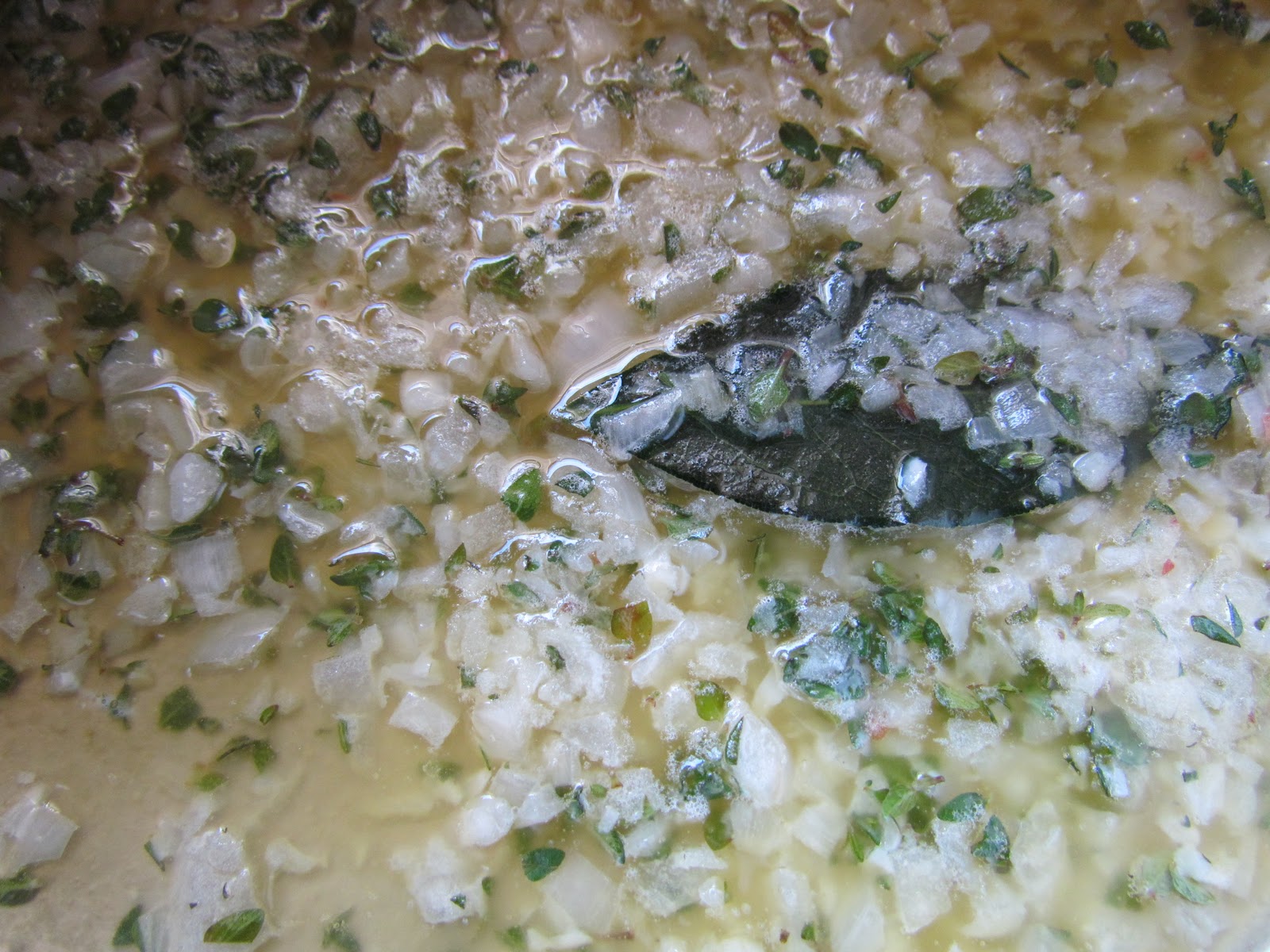
Melt the butter in a medium saucepan over medium heat. Add the bay leaf, shallot, garlic, and thyme, and saute a few minutes until the shallot is soft. Season the liver well with salt and pepper. Increase the heat in the pan a little and add the liver. Cook the liver in the butter mixture, turning occasionally, until the outside begins to color but the inside remains slightly pink (cut it open if you're not sure).  This should not take very long. 
Remove the pan from the heat, add the Sherry, and scrape the bottom of the pan to remove any fond. Set aside for a minute to cool slightly. 
Remove the bay leaf and puree the liver and butter mixture in a blender or food processor along with the allspice, nutmeg, and cream. For a very smooth texture, force the pate through a fine mesh sieve using a  rubber spatula. 
Spoon the pate into ramekins or a small porcelain container and smooth the top. 
Let cool completely, cover the surface directly with plastic wrap, and refrigerate at least a couple hours until cold and the flavors have had a chance to meld. 


Take the pâté out of the refrigerator an hour or two before serving so it warms up a bit and spreads easily. 
Serve with thin slices of a good baguette or good toast points.
The pâté will last only a couple of days, so be sure to make it just before you plan to serve it!

Friday, October 21, 2011

Spiced Nut Trail Mix


It's now fall, the weather is cooler, and we can look forward to comfy-cozy clothes.
Bundling up in sweaters and scarves, perhaps some mittens...


The other day I wore a favorite jacket.
My mother saw me and said, "Please be careful not to put any holes in your jacket."
There was nothing as far as I could tell that prompted the request, it just happened.
I said nothing in reply.
At first I was a little taken aback and confused as to why I would need such and exhortation, but a little later I thought it was hysterical.


See, I'm in the "once you pass the age of three, you probably don't need people telling you not to put holes in your jacket" camp.
(A good strong look is all it'll take, no words are necessary.)
Thirty? Certainly not. It's a tad superfluous in my opinion.
I thought about why the statement was potentially made.
Let's see here... I've not been climbing trees, no bear or alligator westing, I generally try to steer clear of sharks, there's been no jumping of fences, there's not been any close frictional contact with concrete, no street fights, I don't play with ice picks or nail guns, and I've been good with scissors for years. True.


I didn't think I had a penchant for creating holes in my clothes.

Ok, so technically I DO play with knives, but it's a safe sort of play- closed toed shoes and all that jazz (and I don't play with knives with my jacket on, that's completely ridiculous).
Please, Natalie! If you're going to use knives at least take your jacket off!
Things could get dangerous to say the least.


Nope. Nothing that leads me to any logical reason.


Perhaps it can only be chalked up to being part of the "it's a mom thing" category.
Second only to clotheslining anyone who unfortunately happens to be sitting in the passenger seat if you come to a semi-sudden stop while driving.

So, anyway, the trail mix recipe included here is full of warm autumnal flavors.


The original recipe came from a magazine at least 10 years ago... I liked it and have been making a version since with what nuts and dried fruit I could find or whatever sounded good at that moment.
It's perfect to throw into a bag if you're out hiking, great in a desk drawer, in the car for a weekend road trip to look at fall foliage...
Just don't forget your jacket. Preferably one that's completely intact.

Spiced Nut Trail Mix

1 c cashews
1 c dried apricots, quartered (or halved, depending on size)
3/4 c walnut halves
1/2 c shelled sunflower seeds
1/2 c golden raisins
1/2 c dried cranberries
1/2 c sugar
1 t Chinese five spice powder (pumpkin pie spice or a mix of ginger, anise, cloves, allspice, black pepper, and/or nutmeg will also work... choose a few, whatever suits your taste)
1/4 t ground cinnamon
1/8 t cayenne pepper
1/2 t salt
1 large egg white
1 t water

Preheat oven to 225 degrees F. 
In a large bowl stir together cashews, apricots, walnuts, sunflower seeds, raisins, cranberries, sugar, five spice powder, cinnamon, cayenne, and salt. Beat the egg white and water until frothy, then fold gently into the nut and fruit mixture. 
Spread the mixture out onto a nonstick baking sheet (or a regular sheet pan covered with a layer of parchment paper). Bake for 1 hour. 
Remove the pan from the oven and place on a rack to cool completely. 
Break the trail mix into pieces and store in an airtight container. 

Monday, October 17, 2011

Carnitas


To me, carnitas make the perfect burrito.
Not to say I'm a huge pork fan, and I'm not always a meat person, but for some reason when I really crave a burrito, it's always got to be carnitas.


You know, you look at the menu, and entertain the idea of this or that, but when it comes time to order, I just go with the old standby. Perhaps I'm set in my ways when it comes to burritos.
Mildly spicy, slightly sweet, complex. Perfect with guacamole and black beans.


Different chiles do different things, and they have different purposes.
Some are sweet, others are hot. Some have more flavor, others have more... feeling.
Generally, the tiny ones have the intense blistering heat, and the bigger ones are more sedate.


It's like that big huge football player you had class with. He was big- impressively so- and for that very good reason nobody messed with him.

But he was actually only a threat on the field, he had a fairly mild temper when it came to dealing with people in the day-to-day.
Or I suppose we could liken the small chiles to little dogs. They oftentimes make an extremely loud ruckus and act quite violent, don't they? Much moreso than many of the docile, bigger dogs, many of whom don't bat an eyelash when confronted by these little tornados.
Is it a Napoleon complex for dogs?


Hey, the same goes for chiles. 

Poblano chiles are shaped like large jalapeños.
Once they're dried, Poblano chilis become Ancho chiles. They may look like they'd pack a punch (or read like they do since they're chiles), but they really don't.
Ancho chile powder is mild- mild and a little smokey.


Based on David Lebovitz's recipe in The Sweet Life in Paris
It's a little adapted, a little Cuban-ized.
Fantastic as a filling for tacos or burritos, but also good with a bowl of rice and black beans.

Carnitas
serves 10 or more

5 1/2 lb. pork shoulder (boneless), excess fat removed and cut into large pieces
1 generous T kosher salt
2 T vegetable oil

1 1/2 c orange juice
1 T ancho chile powder
1/2 t cumin
3 cloves of garlic, smashed
1 stick of cinnamon
2 bay leaves
Water


Preheat the oven to 350 degrees F. 
Rub pieces of pork all over with salt. In a large roasting pan set over the stovetop, heat the oil over medium high heat. Sear the pork on all sides. Make sure you only have a single layer of pork, if not, sear the pork in two batches. Remove the pork to a plate and blot any excess oil. Pour the orange juice into the pan and scrape up any browned bits stuck to the bottom. Add the chile powder, cumin, garlic, cinnamon stick and bay leaves. Stir through the orange juice to combine. Return the pork back into the pan and add enough water so that the pieces of pork are about two-thirds submerged. 
Braise the meat in the oven for about 3 1/2 hours, turning occasionally. By the end of the cooking time, the pork should be extremely tender and falling apart. Remove the pan from the oven, and place the pork in another 4-sided pan, but do not get rid of the marinade. Place the roasting pan back on the stove and boil until it reduces slightly and becomes a little syrupy.
Meanwhile shred the pork using two forks.
Once the marinade has reached the desired consistency, remove the pan from the heat and add the shredded pork. Quickly turn and stir the pork to coat each bit (the marinade will soak in). 
Serve warm with tortillas or rice.